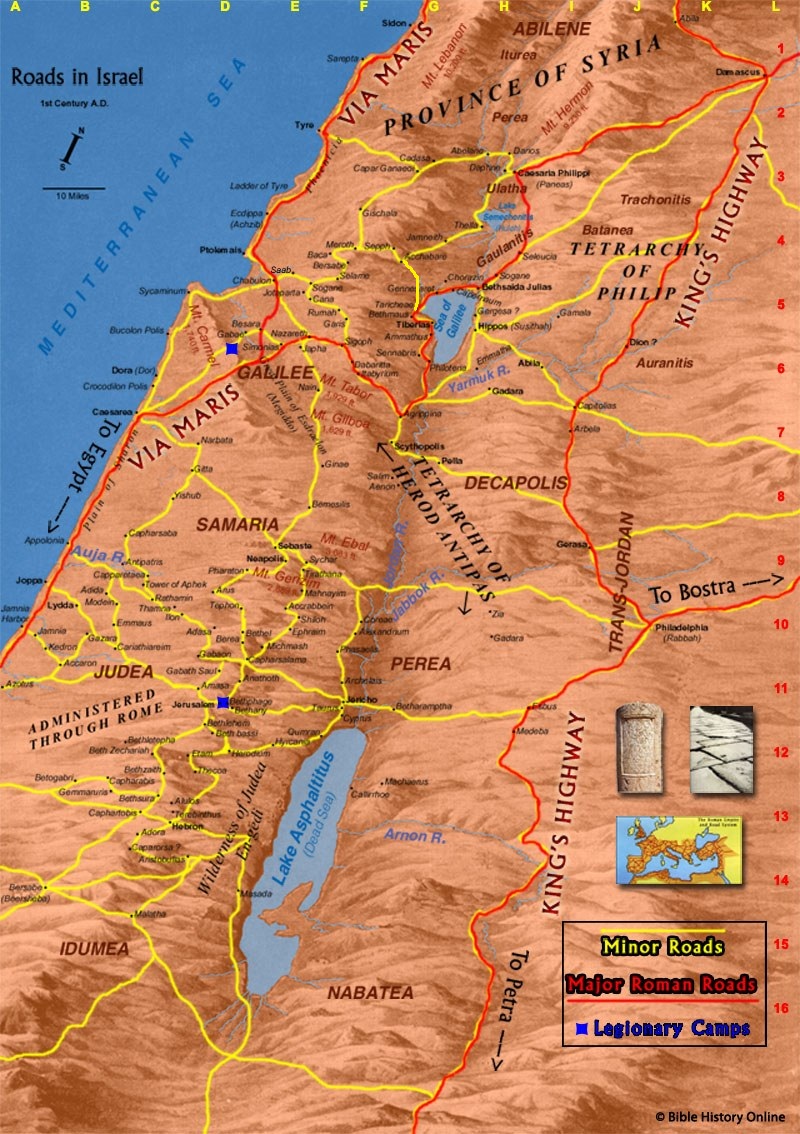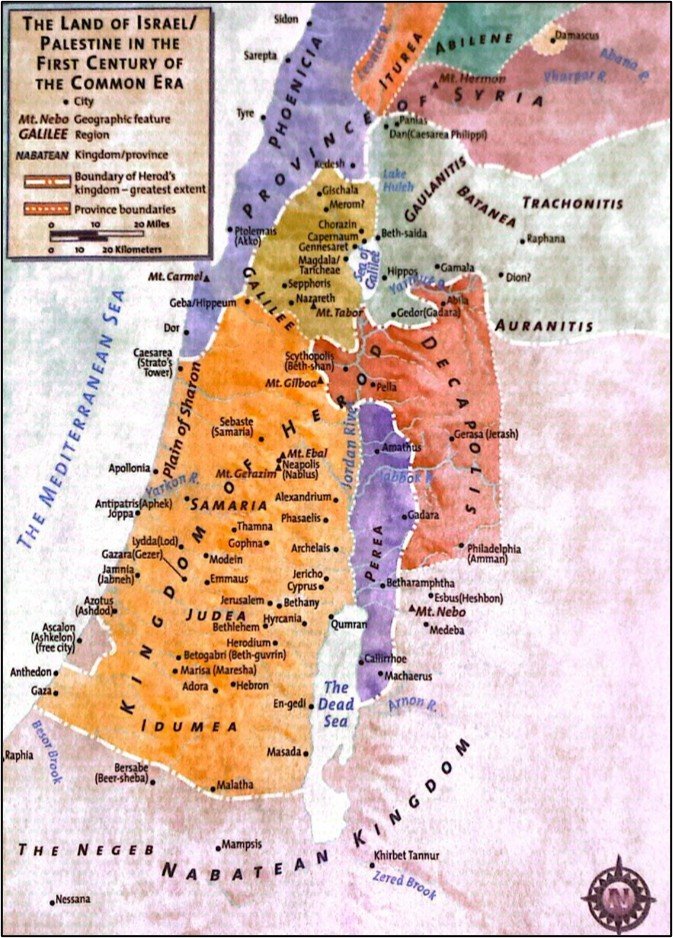
Geopolitical regions of “Israel’ at the time of my story
While writing A Ram for Mars, I had to make a decision about what to call the ancestral homeland of the Jews to which Marcus and Miriam are traveling when the book opens and where the action of the book takes place. I chose “Israel” because the name is meaningful to modern readers. But I did so with great reluctance because the name “Israel” had no clear geographical meaning for the first-century Jews who serve as the focal point of my story. For them, the land consisted of three distinct regions: Judea in the south, Samaria in the center, and Galilee in the north. I use these terms in my story when referring to specific regions, but none is suitable as a designation for the territory as a whole.
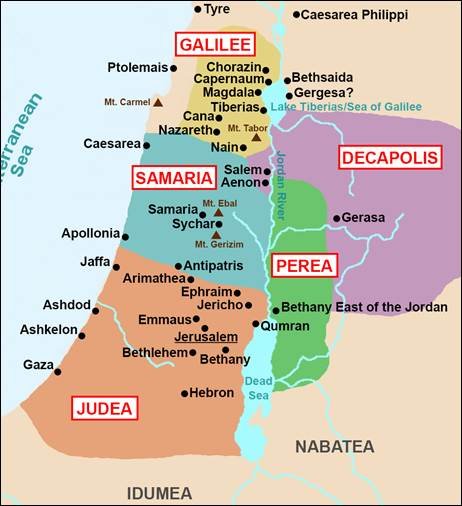
The three major regions of “Israel” in the first century CE
The term “Palestine” is equally anachronistic. It comes from the name of the Philistines, a non-Jewish people that occupied the southern coastal zone for centuries before they were conquered (along with the Israelites) by the invading Babylonians (6th century BCE). The Philistines disappeared from the historical record until the Romans revived the term in the 2nd century CE as part of their broader effort to quash the historic identity of a people-group that had rebelled against them twice by that time. The biblical land of Israel became part of a broader province called “Syria Palestina” that had its capital in Damascus. The name stuck, and “Palestine” became the standard designation for this region from that time until the 20th century. But it was not in use at the time my story takes place.
The land where the nation of Israel stands today has gone by a variety of names over the millennia. The earliest attested name is “Canaan,” which is used in both Egyptian documents and the Bible to refer to a broad swath of territory that included parts of modern-day Israel, Palestine, Lebanon, and the western parts of Jordan and Syria.
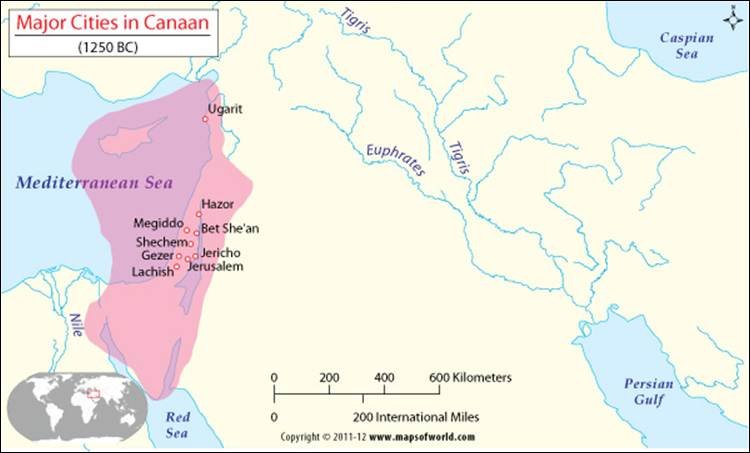
Pink represents the land designated by Egyptian records as “Canaan”
The first datable reference to a people called “Israel” appears in the Merneptah Stele, an Egyptian victory column that dates to around 1208 BCE. In the Bible, the name “Israel” is used for both the land and the people who live there. The boundaries of the land that bears this name vary depending on the date and agenda of the author/editor.
In Genesis 15:18, God promises Abraham and his descendants a land that stretches “from the river of Egypt [the Nile] to the great river, the Euphrates,” covering parts of modern-day Egypt, Saudi Arabia, Jordan, Syria, Lebanon, and Iraq. In Numbers 34, by contrast, a much smaller territory is identified for the invading Hebrews to conquer, a land bounded in the east by the Jordan River, in the west by the Mediterranean Sea, in the north by Lebanon, and in the south by the “brook of Egypt,” a seasonal river that flowed across the northern Sinai region.
According to the later books of Samuel and Kings, the territory of “Israel” was extended by the military campaigns of kings David and Solomon into the lands east of the Jordan River as far as southern Syria and eastern Lebanon. That expansive version of what constitutes “Israel” lasted only until Solomon’s death, after which a rebellion divided the land permanently into “Israel” in the north and “Judah” in the south.
Biblical extent of “Israel” under king Solomon Biblical “Israel” under Solomon’s successors
The Assyrians, who conquered the northern kingdom in 722 BCE, called the northern kingdom either “Bit Omri” (after the Israelite king Omri, whose dynasty ruled for several generations) or “Samaria” (the name of its capital). The Babylonians, who overran the southern kingdom in 586 BCE, called the entire region “Yehud,” a variant of the Jewish name “Judah” (or “Yehudah” in Hebrew). The Persians used the same name while restricting it to the southern region. The Greeks followed the Persian practice, converting “Yehud” into “Ioudaia” in their own language, or “Judea” in English.
The Jewish inhabitants of the land continued to use the biblical name “Israel” in ritual contexts, but in ordinary usage they employed the names assigned by their rulers. Thus by the time of my story Jews used the name “Judea” for the lands in the south, “Samaria” for the central region, and “Galilee” for the hilly north country. That usage continued until the Romans subsumed all three regions under the name “Syria Palestina” in the 2nd century CE.
From that time forward the land was known as “Palestine.” Not until the rise of the Zionist movement in the late 19th century was the name “Israel” revived as a geographic term, and it did not become a political reality until the founding of the state of Israel in 1948, when the name “Palestine” was restricted to those portions of the land that set aside for the Arab population (the areas known in Marcus’s day as Samaria, Galilee, and the Gaza Strip). The land called “Israel” in 1948 was substantially smaller than in the time of David and Solomon, and much smaller also than what the state of Israel occupies today.
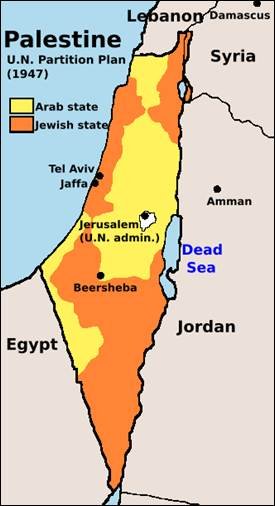
UN partition plan for “Israel”(labelled as Jewish
state) and “Palestine” (labelled as Arab state) (1947)
In short, the term “Israel” has been malleable and ill-defined throughout its history, and neither it nor “Palestine” would have been used by my characters as a reference to the land as a whole except when speaking about the era of their biblical ancestors. But a modern writer has to choose something, even if it’s not historically accurate. Readers who prefer the name “Palestine” over “Israel” are free to make the mental substitution.